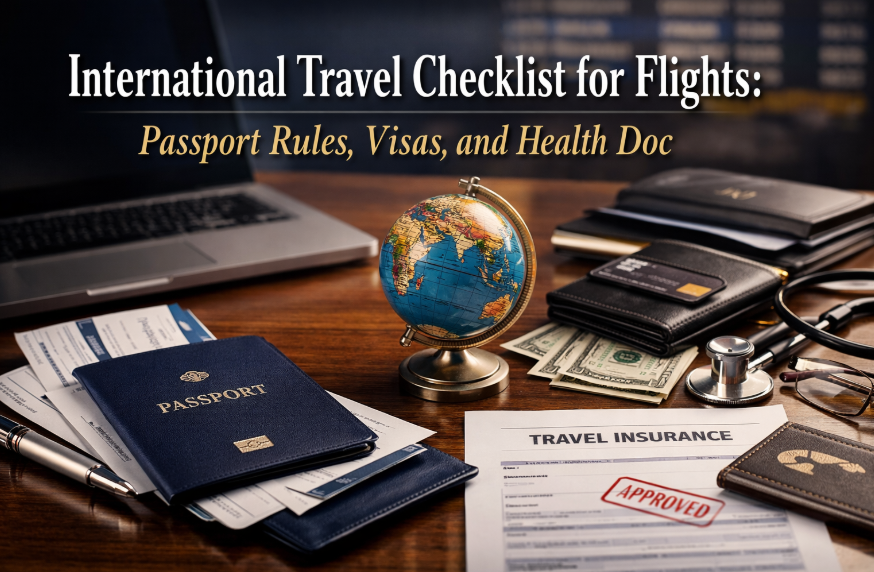
The 48-Hour Rule of Smart Travelers: How to Use This International Flight Checklist
Two days before a flight is the golden hour of preparation—like tightening the bolts on a bridge before you drive across it. The smartest travelers don’t “pack documents”; they stage documents, like a pilot running a pre-flight checklist. In these 48 hours, you confirm passport validity, verify visa requirements, secure health documents, and make sure your airline booking details match your identity exactly—because international aviation is a strict librarian that hates typos.
Use this international travel checklist like a compass with three directions: rules, proof, and backups. Rules are your passport rules and visa regulations. Proof is what immigration or airlines may ask you to show: onward tickets, accommodation reservations, travel insurance, vaccine certificates, financial proof. Backups are your insurance policy against chaos: digital copies, printed copies, and offline storage. If travel is a river, your documents are the stones you step on—skip one, and you’re suddenly swimming with your suitcase.
The “Three Pockets” system: body, bag, cloud
Keep critical travel documents in three “pockets,” like a magician never relying on one sleeve. Pocket one (body): passport, one payment card, phone. Pocket two (bag): printed itinerary, extra card, spare copies. Pocket three (cloud): scans and photos of every document stored securely. This layered system turns document loss from a disaster into an inconvenience.
Document mistakes that trigger airport delays
The airport doesn’t punish you loudly; it punishes you silently—by making you wait. Common delays come from passport validity issues, missing visa approvals, mismatched ticket names, and incomplete health entry forms. Each mistake is a pebble in the runway, small but powerful enough to stop a plane from taking off.
Quick pre-flight verification steps
Before you sleep, run a five-minute check: passport expiry date, visa status, health documents, flight booking name match, and proof documents. Think of it as locking your front door—simple, repetitive, and life-saving.
Passport Rules for International Flights: Validity, Damage, and Name Matching
A passport is not just a booklet; it’s a permission slip written in ink and security threads. Airlines treat your passport like a key—if it doesn’t fit perfectly, the door doesn’t open. That’s why passport rules for international flights matter more than your suitcase, your hotel, and even your excitement. The passport is the crown jewel of your travel checklist, and its smallest flaw can become a border-sized problem.
Start with the basics: passport validity, passport condition, and name matching. Immigration officers and airline staff aren’t judging your fashion; they’re judging your data. They want certainty. Your passport must be valid long enough, readable enough, and consistent enough with your booking. If travel is a theater, your passport is your ticket—no ticket, no show, no matter how much you paid.
The 6-month passport validity rule
Many countries apply a 6-month passport validity rule, meaning your passport must be valid for at least six months beyond your arrival date (sometimes beyond your departure date). Think of it as a safety buffer—like extra fuel in the tank. Even if your trip is short, some borders won’t accept a passport that looks “too close to sunset.” Always check the destination’s passport rule before you fly, because airline staff often enforce it at check-in.
Blank pages and immigration stamps
Some destinations require a minimum number of blank passport pages for stamps and visas. A passport with no space left is like a notebook with no empty lines—there’s nowhere to write your entry. Keep at least two blank pages, and more if you’re hopping across multiple countries.
Passport damage and wear—what counts as “invalid”
A damaged passport can be rejected, even if it’s technically valid. Water damage, torn pages, loose binding, or unreadable machine-readable zones can trigger refusal. Borders want a clean signal. If your passport is the radio, damage is static—nobody wants to guess the song while crossing a border.
Matching names across tickets, IDs, and passports
Your flight booking name must match your passport name closely. Airlines can be strict about spelling, order, and missing surnames. If your passport includes multiple surnames or a long legal name, book accordingly. A name mismatch is like trying to unlock a door with a similar key—it looks right until it doesn’t.
Visa Requirements by Country: Tourist Visa, eVisa, Visa on Arrival, and Transit Visas
Visa rules are the invisible fences of international travel. You don’t see them from the airplane window, but they exist, and they are very real. A visa requirement can change your entire trip from “smooth landing” to “denied boarding,” because airlines often check visas before you even reach immigration. This is why your international travel checklist for flights must treat visas like oxygen: you only notice them when they’re missing.
There are many visa types—tourist visa, eVisa, visa on arrival, and the sneaky one: the transit visa. Each comes with timelines, fees, and document proof requirements. And here’s the big secret: the best travelers don’t just ask “Do I need a visa?” They ask, “What proof do I need to show the airline and immigration to prove I meet the entry requirements?”
How to confirm visa rules for your destination
Visa requirements depend on your passport nationality, destination, trip purpose, and length of stay. Confirm through official government immigration websites or your destination’s embassy. Then double-check airline guidance, because airlines can apply strict boarding rules based on entry regulations.
eVisa vs visa on arrival—pros, cons, timelines
An eVisa is like booking a seat in advance: fewer surprises, more control. You apply online, upload documents, pay fees, and receive approval before flying. A visa on arrival is like showing up early and hoping the line is kind—possible, but uncertain. If your trip is time-sensitive, eVisa is often safer because it reduces airport immigration delays and documentation confusion.
Transit visas and hidden layover traps
Transit rules can be the trapdoor under the red carpet. Even if you’re “just connecting,” some countries require a transit visa if you change terminals, pass immigration, or have a long layover. Always check transit visa requirements for your layover country, not just your final destination.
Proof-of-onward travel and accommodation requirements
Many immigration systems want proof that you will leave—like a boomerang that returns. Carry proof-of-onward travel (return ticket or onward ticket), and keep accommodation details (hotel booking or invitation letter). These documents act like your travel “alibi,” showing you’re a visitor, not a mystery.
Health Documents for International Travel: Vaccines, Insurance, and Entry Forms
Health documents are the new seatbelts of global travel. You can ignore them—until the moment you need them, and then you wish you had buckled up earlier. Many destinations require specific health documents for international travel, such as vaccination certificates, health declaration forms, or proof of travel medical insurance. These requirements shift like weather, so your checklist must be living, not fixed.
Treat health documents like a protective shield: vaccination proof, travel insurance documentation, and medication paperwork. The goal isn’t fear—it’s frictionless entry. You want to walk through health screening like a VIP through a velvet rope: prepared, calm, and credible.
Vaccine certificates and country entry health rules
Some countries require proof of vaccines such as yellow fever (especially if you’re arriving from certain regions) and may have other entry health requirements depending on global conditions. Keep your vaccine certificate in both physical and digital form, because border officials may request the original.
Travel health insurance documents and coverage proof
Even when not mandatory, travel health insurance is your financial parachute. Carry your insurance policy certificate, emergency contact number, coverage summary, and claim instructions. If travel is a high wire act, insurance is the safety net—quietly present, priceless when needed.
Digital health forms and arrival declarations
Many countries use online arrival health declarations or digital entry forms. Complete them before departure when possible, and save confirmation emails or QR codes offline. These forms can be the “digital stamp” that opens the gate.
Medication letters and prescription proof
If you travel with prescription medication, carry a doctor’s letter and original prescription packaging. Some medications are restricted in certain countries, so confirm rules before you fly. Your medicine should not become a misunderstanding at customs.
Flight Booking Details That Must Match Your Travel Documents
Your airline ticket is the choreography; your passport is the dancer. If the names don’t match, the dance stops mid-song. Airlines are strict because they are the first checkpoint in the border chain. If they board someone who can’t enter, airlines can be penalized—so they become gatekeepers with sharp eyes.
Check every booking detail like a jeweler inspecting a diamond: full name, date of birth, passport number, and sometimes passport expiry if you pre-filled it in airline systems. Even small differences can trigger extra screening, delays, or denied boarding, especially on international flights with strict immigration compliance.
Airline name rules and middle name confusion
Some airlines ignore middle names, others include them, and a few can be painfully strict. The safest approach is to book the name as close as possible to your passport’s machine-readable section. If your passport shows a long legal name, match it. If you have a single name or special naming format, check airline policies early.
Frequent flyer profiles, passport updates, and TSA-style checks
If you use a frequent flyer profile, update it with your current passport details. Old passport numbers and expired documents in your airline profile can create silent errors that show up at check-in like a ghost in the machine.
Common booking errors and fixes
Common problems include misspellings, reversed first/last names, missing surnames, and wrong date of birth. Fix these immediately through the airline, because some changes become harder after online check-in opens. The earlier you repair the crack, the less likely it becomes a fracture.
Money & Proof Documents: Bank Cards, Cash Rules, and Financial Proof
Money is the quiet language of borders. Immigration rarely asks, but when they do, they ask sharply: “Can you support yourself?” Proof of funds is like showing you brought enough oxygen for your hike. It’s not about being rich; it’s about being responsible.
Prepare a basic financial proof kit: accessible bank cards, emergency cash, and documents that show you can pay for your stay. Some travelers get questioned because their travel story looks incomplete. Strong proof documents make your story coherent—and coherence is what immigration loves.
Proof of funds for immigration
Some countries may require proof of sufficient funds, such as recent bank statements, credit card limits, or cash evidence. Keep digital bank statements downloaded securely, and avoid relying on internet access. Immigration doesn’t want excuses; they want proof.
Currency declaration rules
Many countries require currency declarations above certain thresholds. Know the cash limit rules before you travel, especially if you carry cash for safety. A declaration is not a crime—it’s a compliance step, like telling airport security you have a laptop in your bag.
Backup payment plan for international travelers
Bring at least two payment cards (stored separately), and consider a backup method like a digital wallet. If one card fails, you don’t want your trip to freeze like a screen with no signal.
The Airport Survival Folder: Printouts, Screenshots, and Offline Access
The airport is not the best place to depend on Wi-Fi. It’s a place of moving crowds and disappearing signals. Your airport survival folder is your offline lighthouse—guiding you when the internet fades.
Build a travel document folder that works in three modes: online, offline, and paper. Airlines and immigration may accept digital proof, but when systems fail, paper becomes king again. Think of printouts as spare tires: you don’t use them every day, but when you need them, you really need them.
What to print vs what to keep digital
Print your flight itinerary, accommodation confirmation, travel insurance certificate, and visa approval letter (if applicable). Keep digital copies of everything on your phone and cloud storage. If your phone battery dies, paper keeps walking.
Offline storage tactics
Save PDFs and screenshots offline: passport photo page scan, visa approval, QR codes, insurance certificate, and emergency contacts. Use a password-protected folder. Your phone becomes a mini filing cabinet.
Emergency contacts and embassy info
Store your destination embassy contact details, local emergency numbers, and a trusted contact at home. If travel is a maze, these are the exit signs.
Final Pre-Departure Checklist: Day-of-Flight Document and Security Steps
Departure day is a river crossing—you don’t want to be searching your pockets mid-stream. The goal is smooth sequencing: check-in, baggage, security, immigration, boarding. Each step is a gate, and each gate likes a different key.
On the day of travel, keep your most important items in easy reach: passport, boarding pass, visa proof, and health documents. If you’re constantly digging through bags, you’re giving stress a free seat next to you. Preparation turns the airport from a battlefield into a hallway.
Check-in, baggage, and boarding sequence
Arrive early, especially for international flights. Check-in staff may ask for passport, visa, onward ticket, and health documents. If your documents are organized, the interaction becomes quick and professional—like showing a prepared script rather than improvising.
Immigration departure checks
Some countries have departure immigration controls. You may need to show proof documents again. Keep calm, answer clearly, and let your documentation do the talking.
Last-minute recovery plan
If something goes wrong—passport damage discovered, visa missing, health form incomplete—your recovery plan is to contact the airline, check official immigration rules, and use your backups. Panic is a loud liar; documents are quiet truth.
Conclusion
International travel is a long poem written in stamps, tickets, and screens—but the best poems have structure. With this international travel checklist for flights, you’re not just packing documents; you’re building a bridge over uncertainty. Your passport rules become your foundation, your visa requirements become your map, and your health documents become your shield. And when you step into the airport, you’ll feel it: calm isn’t luck—it’s preparation.
FAQs
1) What is the 6-month passport validity rule for international travel?
The 6-month passport validity rule means many countries require your passport to be valid for at least six months beyond your travel date, so airlines and immigration can approve entry safely.
2) Do I need a visa if I’m only transiting through a country?
Sometimes yes, because transit visa requirements depend on your nationality, layover length, terminal changes, and whether you must pass immigration during your connection.
3) What health documents do I need for international flights?
Health documents may include vaccine certificates, travel health insurance proof, and digital health declaration forms, depending on destination entry requirements and current regulations.
4) What documents should I print for international travel?
Print your flight itinerary, visa approval, accommodation booking, travel insurance certificate, and any QR codes for entry forms, because airport Wi-Fi is not always reliable.
5) What if my flight ticket name doesn’t match my passport exactly?
A name mismatch can cause delays or denied boarding, so contact the airline immediately to correct spelling, order, or missing surnames before check-in.
Read More